How to Find the Best Protein Powder for Triathletes

📌 Overview and Key Takeaways

This is a Dietitian’s guide on how to find the best protein powder for triathletes.

Discover how to supplement your protein intake as a triathlete.

drink wholesome founder
Last Updated
Jan 13, 2026
Author and Medical Reviewer

Written by Jack, CNC

Jack is a National Academy of Sports Medicine Certified Nutrition Coach.

Is Protein Powder Good for Triathletes?

If you think that a triathlon consists of three events, you probably overlooked the fourth and arguably most important event: nutrition.

Nutrition takes place before, during, and after training and can be the difference between a new PR and a DNF.

Moreover, what you eat while training can support or sabotage your hard work.

Believe it or not, protein is just as important for endurance athletes as it is for weightlifters as it helps with exercise recovery, injury prevention, and immune system health.

Moreover, many triathletes do not consume nearly enough protein, which can have a serious negative impact on their performance.

If you do not get enough protein when training hard, your body will break down muscle for use as fuel.

This will eventually make you slower in the long run, no matter who you are.

As a triathletes, building and maintaining muscle mass is beneficial for several reasons:

  • Improved efficiency: Strong muscles can better absorb impact and propel you forward with each stride and stroke, leading to more efficient technique.
  • Reduced risk of injury: Strong muscles provide better support and stability to joints, decreasing the risk of common injuries, such as shin splints.
  • Enhanced performance: Increased muscle mass can contribute to greater power output, enabling you to swim, bike, and run faster and with more endurance.

It is recommended that triathletes eat 0.4 grams of protein per kilogram of bodyweight per meal across a minimum of four meals in order to reach a minimum of 1.6 grams of protein per kilogram of bodyweight per day (J Int Soc Sports Nutr, 2018).

Eating this much protein can be challenging for some triathletes, especially those with busy schedules or dietary restrictions, which is where protein powder can help.

Adding a scoop of protein powder to your diet is an easy way to fill in gaps in your fueling regimen and ensure you are meeting your protein goals.

It can easily be added to smoothies, oatmeal, and other recipes, or simply mixed with milk or water to make a protein shake.

Daily Protein Intake Calculator

[Popup] Protein Calculator

Calculate your daily protein needs.

press Enter
Are you pregnant or breastfeeding?

g protein/day
Use Shift+Tab to go back

What Is the Best Protein Powder for Triathletes?

The type of protein powder that you use is not particularly important.

That is, as long as you are eating a balanced diet, any type (egg white, pea, whey, etc.) of protein powder can help you meet your protein needs.

Not all protein powders are created equal, however; many protein powders contain ingredients that can cause painful side effects and long term health problems.

Among these ingredients are food additives, dairy-based proteins, and protein concentrates/isolates.

avoid food additives

🚫 Avoid Food Additives

Not only can food additives cause digestive issues like bloating, diarrhea, and stomach pain, but they can also alter the composition of your gut microbiome – the collection of microorganisms living in your gut (North Clin Istanb, 2019).

This can lead to gut dysbiosis, or an imbalance in gut bacteria, which can impact your performance (Microorganisms, 2022).

For example, a healthy gut microbiome regulates energy metabolism by supplying muscles with oxygen and nutrients during intense exercise (J Sport Health Sci, 2016).

It also reduces inflammation and expedites tissue repair, helping to improve performance and expedite recovery (Gut, 2018).

⚠️ Here is a list of the most common food additives in protein supplements:

  • acacia fiber
  • acacia gum
  • acesulfame potassium
  • artificial flavors
  • ascorbic acid
  • aspartame
  • calcium carbonate
  • carrageenan
  • cellulose gum
  • dextrin
  • dicalcium phosphate
  • dipotassium phosphate
  • erythritol
  • gellan gum
  • guar gum
  • gum arabic
  • inulin
  • locust bean gum
  • maltitol
  • maltodextrin
  • mono- and diglycerides
  • ‘natural’ flavors
  • rice bran extract
  • rice dextrin
  • rice hulls
  • rosemary extract
  • silica
  • silicon dioxide
  • sodium alginate
  • soluble corn fiber
  • sorbitol
  • soy lecithin
  • sucralose
  • sunflower lecithin
  • tocopherols
  • tricalcium phosphate
  • xanthan gum
  • xylitol
  • zinc oxide

As a rule of thumb, if you cannot find it in nature or make it at home, it is probably a food additive.

🚫 Avoid Dairy-Based Proteins

Dairy-based proteins like whey and casein, although not an issue for everyone, can cause digestive issues.

This is usually because they contain lactose, a sugar many individuals with sensitive stomachs cannot fully digest.

But you might be sensitive to dairy-based proteins even if you are not lactose intolerant.

This is particularly true for casein protein, which forms a gel-like substance in your stomach that slows down digestion.

avoid ultra processing

🚫 Avoid Protein Concentrates and Isolates

You might also want to avoid ultra-processed protein concentrates and isolates.

Most protein supplements are made from one or both of these ultra-processed protein sources, which have been mechanically and/or chemically stripped of everything but the protein.

This includes the enzymes, fiber, and other natural digestive aids that help your gut break them down.

You therefore do not digest them in the same way that you do whole foods, which could affect your gut health.

Studies show that regularly eating protein concentrates and isolates might disrupt your gut microbiome and cause the formation of toxic byproducts in your gut (Nutrients, 2018; Mol Nutr Food Res, 2024).

You should thus look for protein supplements made from whole food protein sources like egg whites and almonds, which are easier to digest and absorb.

Order Samples to see for yourself.

Product Quiz

Product Quiz

Find the best product for you.

press Enter
What is your main goal?
Are you on a vegan diet?
Are you on a low sodium diet?
Do you prefer flavored or unflavored?
How would you typically use our products?
What's your sex (assigned at birth)?
What's your age?
Do you have sensitive stomach?
Have you ever been diagnosed with a digestive disease?
Select your condition(s).
Use Shift+Tab to go back

Sources

  1. Journal of the International Society of Sports Nutrition (J Int Soc Sports Nutr). How much protein can the body use in a single meal for muscle-building? Implications for daily protein distribution. 2018.
  2. Northern Clinics of Istanbul (North Clin Istanb). Food additives and microbiota. 2019.
  3. Microorganisms (Microorganisms). Gut Microbiota Dysbiosis: Triggers, Consequences, Diagnostic and Therapeutic Options. 2022.
  4. Journal of Sport and Health Science (J Sport Health Sci). Endurance exercise and gut microbiota: A review. 2016.
  5. Gut (Gut). The microbiome of professional athletes differs from that of more sedentary subjects in composition and particularly at the functional metabolic level.. 2018.
  6. Nutrients (Nutrients). Effect of a Protein Supplement on the Gut Microbiota of Endurance Athletes: A Randomized, Controlled, Double-Blind Pilot Study. 2018.
  7. Molecular Nutrition & Food Research (Mol Nutr Food Res). In Vitro Fermentation of Animal and Plant Protein Isolates by the Human Gut Microbiota Under High and Low Carbohydrate Conditions.. 2024.

Editorial Guidelines


This article was written by a Registered Dietitian and reviewed by a Physician Assistant. We rely on peer-reviewed research and trusted medical sources, and regularly update our content to ensure accuracy and clarity.

Frequently asked questions

Who is Drink Wholesome for?

Drink Wholesome makes minimally-processed protein powder for sensitive stomachs. Because our protein powder is additive, dairy, and gluten-free and made from a short list of simple ingredients, it’s a great option for people with lactose intolerance, IBS, GERD, and SIBO.

Why is Drink Wholesome easy to digest?

No Dairy 

Drink Wholesome is made without whey and casein, which often contain lactose, a sugar most people can’t fully digest. Some caseins also release a bioactive peptide during digestion that has been linked to digestive issues in some individuals.

No Additives

Drink Wholesome is made without food additives. Regularly eating certain emulsifiers, thickeners, and other ultra-processed additives can contribute to gut dysbiosis, which has been linked to chronic digestive issues.

Whole Food Protein

Other protein powders are made from ultra-processed protein concentrates and isolates, which have been mechanically and/or chemically stripped of non-protein components that promote digestion. Drink Wholesome, on the other hand, is made from whole food protein sources, which might be more gut-friendly.

Collagen vs egg white vs almond protein powder?

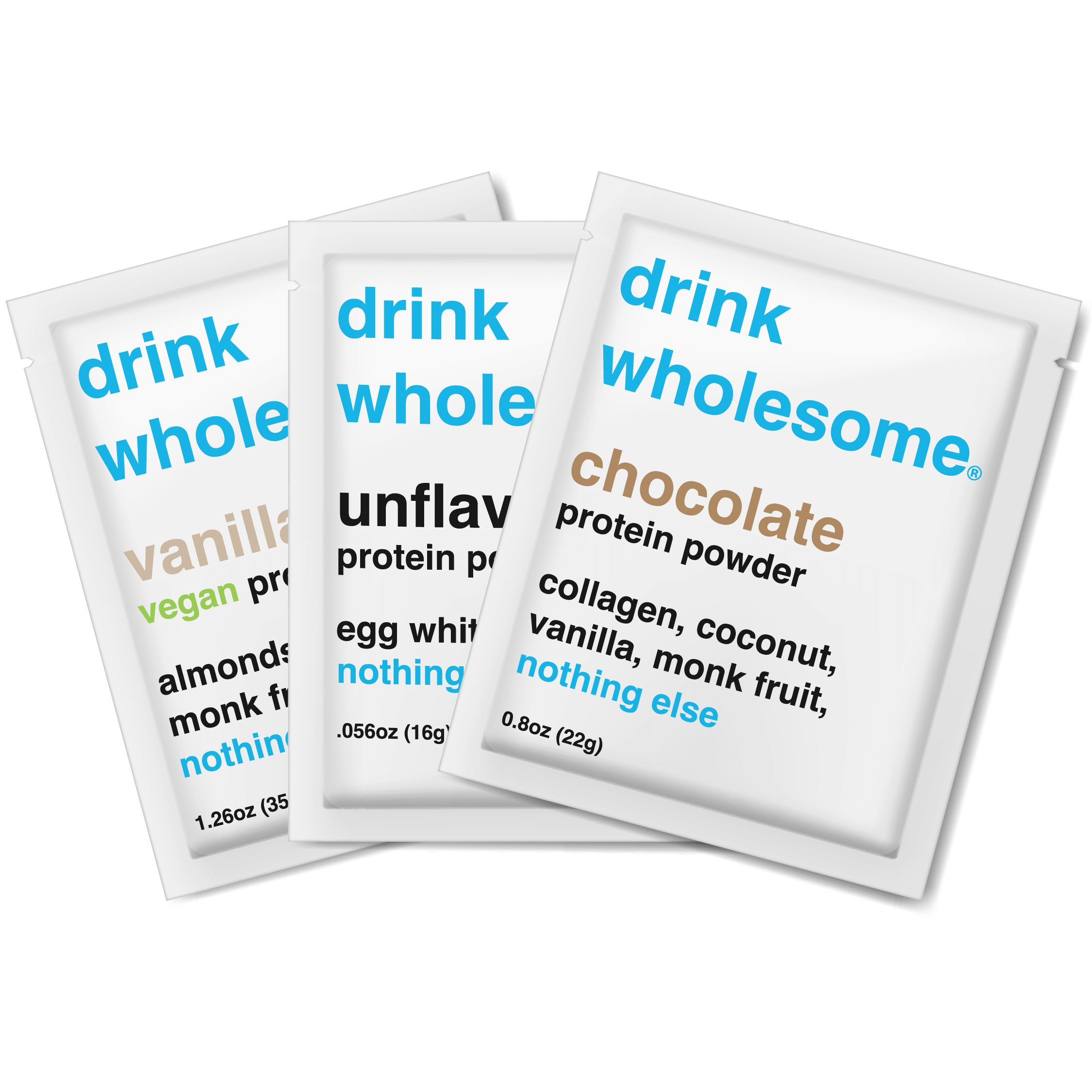
We make three types of minimally-processed Protein Powder for sensitive stomachs: Collagen Protein Powder, Egg White Protein Powder, and Vegan Almond Protein Powder. As long as you eat a balanced diet, any type of protein powder can help you meet your protein needs. So just pick the type that best suits your personal preferences.

Ask our dietitian.

If you’re wondering which of our products is best for you, ask our Registered Dietitian. They’ll reply via email within 24 hours.

Ask Our Dietitian
Name
Name
First
Last

High Protein Blueberry Pancakes

PREP TIME

5 min

COOK TIME

5 min

SERVES

2

Ingredients
  • ¼ cup Drink Wholesome
  • ⅓ cup flour
  • 2 egg whites
  • ¼ cup plant milk
  • 1 tbsp nut butter
  • 2 tbsp maple syrup
  • 1 cup blueberries
Instructions

In a blender, combine the egg whites, milk, ¼ cup blueberries, and almond butter. Pour the mixture into a small mixing bowl and add the protein powder and flour. Whisk until smooth. Pour ⅓ cup batter onto a heated and greased (or non-stick) pan to form pancakes. Cook each side for 2-3 minutes. This recipe makes 4-5 pancakes. Then, in a small saucepan, heat ¾ cup blueberries and the maple syrup over medium heat, stirring occasionally, for about 8 minutes. Plate the pancakes and spoon blueberry jam on top.