How to Find the Best Dairy-Free Soy-Free Protein Powder

📌 Overview and Key Takeaways

This is a Certified Nutrition Coach’s guide on how to find the best dairy-free, soy-free protein powder.

Discover how to safely meet your protein needs without dairy or soy.

drink wholesome founder
Last Updated
Jul 21, 2026
Author and Medical Reviewer

Written by Jack, CNC

Jack is a National Academy of Sports Medicine Certified Nutrition Coach.

Disclaimer: This article is for general informational purposes only and is not a substitute for personalized medical advice. Consult a licensed healthcare professional before making changes to your diet.

Dairy-Free Soy-Free Protein Powder

Why Should I Use Soy-Free Protein Powder?

Here are the top 3 reasons why you should choose a soy-free protein powder:

1. Soy contains isoflavones, which are plant compounds similar to human estrogen.

  • Isoflavones can bind to estrogen receptors in the human body.
  • This binding can cause weak estrogenic or anti-estrogenic activity.
  • One large prospective study found that soy supplement use was associated with increased risk of breast cancer in women over the age of 50 with genetic predispositions (Am J Clin Nutr, 2019).

2.Soybean cultivation is a primary driver of deforestation.

  • Soy is the leading source of protein for animal feed.
  • It is second only to beef when it comes to driving global deforestation and soil erosion.

3. Soy is among the most genetically modified (GM) crops on the planet.

  • These crops are engineered to survive the direct application of herbicides and pesticides.
  • Over 90 percent of soybeans grown on US farms are genetically engineered to withstand an herbicide called Roundup.
  • US-grown GM soybeans therefore contain high residues of glyphosate.
  • Glyphosate is the primary ingredient in Roundup and a probable human carcinogen (Food Chem, 2014).

To summarize, soybeans are a cheap, protein-rich legume.

Many people choose to avoid it, however, because it is a common allergen and potentially associated with estrogenic effects at high doses.

It is also the epitome of a genetically modified crop that can have detrimental impacts on the environment and human health.

Why Should I Use Dairy-Free Protein Powder?

Here are the top reasons why you should choose a dairy-free protein powder:

1. Dairy can cause digestive issues because it contains lactose.

  • Lactose is a sugar that most adults cannot fully digest.

2. Dairy can cause digestive issues because it contains casein.

  • The digestion of some caseins releases a bioactive peptide that has been linked to digestive issues (Adv Nutr, 2017).
  • Casein also forms a gel-like substance in your stomach that slows down digestion (Crit Rev Food Sci Nutr, 2023). For sensitive individuals, slower digestion can contribute to bloating, constipation, and other side effects.

2. Dairy is also known to cause acne.

  • It indirectly stimulates insulin production, which regulates sebum production.
  • Sebum is an oily, waxy substance that can clog your pores and cause pimples.

3. Industrial dairy production has a profoundly negative impact on the environment.

  • Dairy cows and their manure produce enormous amounts of greenhouse gas emissions.
  • Manure and fertilizers pollute local water resources.
  • Feed production leads to the loss of ecologically important areas such as prairies, wetlands, and forests.

Although dairy is cheap, protein-rich, and delicious, it can upset your stomach, cause you to break out, and harm the environment.

Product Quiz

Product Quiz

Find the best product for you.

press Enter
What is your main goal?
Are you on a vegan diet?
Are you on a low sodium diet?
Do you prefer flavored or unflavored?
How would you primarily add Drink Wholesome to your diet?
What's your sex (assigned at birth)?
What's your age?
Do you have sensitive stomach?
Do you regularly experience any of the following? Select all that apply.
Have you ever been diagnosed with a digestive condition?
Select your condition(s).
Use Shift+Tab to go back

What Is the Best Dairy and Soy-Free Protein Powder?

A protein powder that is both dairy and soy-free must be free from dairy-based proteins like whey and casein.

It must also be free from soy-based proteins and ingredients derived from milk or soy beans.

This includes common additives like sodium caseinate (milk derivative) and soy lecithin (soy derivative).

It is worth mentioning that many protein powders contain lecithin, but do not specify if it is soy lecithin.

An easy way to find out is to check if soy is listed as an allergen.

If it is, your protein powder contains soy lecithin.

It is also important to acknowledge that lactose-free does not mean dairy-free.

A lactose-free food does not contain any lactose, but it might still contain dairy.

Some whey protein isolates, for example, are lactose-free, but not dairy-free.

It is worth adding that if you are looking to avoid dairy and soy for reasons related to digestive health, you also want to avoid food additives and protein concentrates and isolates.

Ingredients like these can cause painful side effects and even long-term health problems.

avoid food additives

🚫 Avoid Food Additives

Emulsifiers, thickeners, and other ultra-processed additives can upset your stomach because they are hard to break down and absorb.

They can also alter the composition and function of your gut microbiome – the collection of microorganisms living in your gut (North Clin Istanb, 2020).

These shifts, known as gut dysbiosis, have been shown to contribute to a wide range of chronic diseases, including obesity, type 1 diabetes, and colorectal cancer (J Exp Med, 2019).

Gut dysbiosis is so problematic because it causes a cascade of problems, including intestinal permeability, systemic inflammation, impaired nutrient absorption, and reduced short-chain fatty acid (SCFA) production.

⚠️ Here is a list of the most common food additives in protein shakes and powders:

  • acacia fiber
  • acacia gum
  • acesulfame potassium
  • artificial flavors
  • ascorbic acid
  • aspartame
  • calcium carbonate
  • carrageenan
  • cellulose gum
  • dextrin
  • dicalcium phosphate
  • dipotassium phosphate
  • erythritol
  • gellan gum
  • guar gum
  • gum arabic
  • inulin
  • locust bean gum
  • maltitol
  • maltodextrin
  • mono- and diglycerides
  • ‘natural’ flavors
  • rice bran extract
  • rice dextrin
  • rice hulls
  • rosemary extract
  • silica
  • silicon dioxide
  • sodium alginate
  • soluble corn fiber
  • sorbitol
  • soy lecithin
  • sucralose
  • sunflower lecithin
  • tocopherols
  • tricalcium phosphate
  • xanthan gum
  • xylitol
  • zinc oxide

As rule of thumb, if you could not find it in nature or make it at home, it is probably a food additive.

avoid ultra processing

🚫 Avoid Protein Concentrates and Isolates

If you have a sensitive stomach, you might also want to avoid protein concentrates and isolates.

Most protein shakes and powders are made from one or both of these ultra-processed protein sources, which have been mechanically and/or chemically stripped of everything but the protein.

This includes the enzymes, fiber, and other natural digestive aids that help you break them down.

You therefore do not digest them in the same way that you do whole foods, which could affect your gut health.

For example, one study shows that regularly consuming protein concentrates and isolates might disrupt your gut microbiome (Nutrients, 2018).

Another study shows that it could cause the formation of toxic byproducts in your gut (Mol Nutr Food Res, 2024).

Although further research is needed, individuals with sensitive stomachs can play it safe by choosing protein shakes and powders made from minimally-processed protein sources like egg whites and almonds.

They are more gut-friendly.

Order Samples to see for yourself.

Sources

  1. The American Journal of Clinical Nutrition (Am J Clin Nutr). Use of dietary supplements containing soy isoflavones and breast cancer risk among women aged >50 y: a prospective study. 2019.
  2. Food Chemistry (Food Chem). Compositional differences in soybeans on the market: glyphosate accumulates in Roundup Ready GM soybeans. 2014.
  3. Advances in Nutrition | Journal (Adv Nutr). Systematic Review of the Gastrointestinal Effects of A1 Compared with A2 β-Casein. 2017.
  4. Critical Reviews in Food Science and Nutrition (Crit Rev Food Sci Nutr). Milk proteins: Processing, gastric coagulation, amino acid availability and muscle protein synthesis. 2023.
  5. Northern Clinics of Istanbul (North Clin Istanb). Food additives and microbiota. 2020.
  6. The Journal of Experimental Medicine (J Exp Med). The gut microbiome: Relationships with disease and opportunities for therapy. 2019.
  7. Nature (Nature). Artificial sweeteners induce glucose intolerance by altering the gut microbiota. 2014.
  8. Nutrients (Nutrients). Effect of a Protein Supplement on the Gut Microbiota of Endurance Athletes: A Randomized, Controlled, Double-Blind Pilot Study. 2018.
  9. Molecular Nutrition & Food Research (Mol Nutr Food Res). In Vitro Fermentation of Animal and Plant Protein Isolates by the Human Gut Microbiota Under High and Low Carbohydrate Conditions. 2024.

Editorial Guidelines


This article was written by a Certified Nutrition Coach and reviewed by a Registered Dietitian. We rely on peer-reviewed research and trusted medical sources, and regularly update our content to ensure accuracy and clarity.

Frequently asked questions

Who Is Drink Wholesome for?

Drink Wholesome makes protein powder for sensitive stomachs, GERD, IBS, and other gut issues. It’s suitable for most food sensitivities, including lactose intolerance, and won’t cause side effects like bloating, constipation, and reflux.

Why Is Drink Wholesome Good for Sensitive Stomachs?

Drink Wholesome is the best protein powder for sensitive stomachs because it’s additive, dairy, and gluten-free. It’s also made from minimally-processed protein sources like egg whites and almonds. Other protein powders are made from ultra-processed protein concentrates and isolates, which look nothing like real food.

What’s the Difference Between Protein Powder and Meal Replacement Powder?

Drink Wholesome makes gut-friendly Protein Powders and Meal Replacement Powders. Protein powder is high in protein and low in everything else, whereas meal replacement powder contains fats, carbs, fiber, and protein because it’s intended to replace the nutritional value of a balanced meal.

What’s the Difference Between Almond, Collagen, and Egg White Protein?

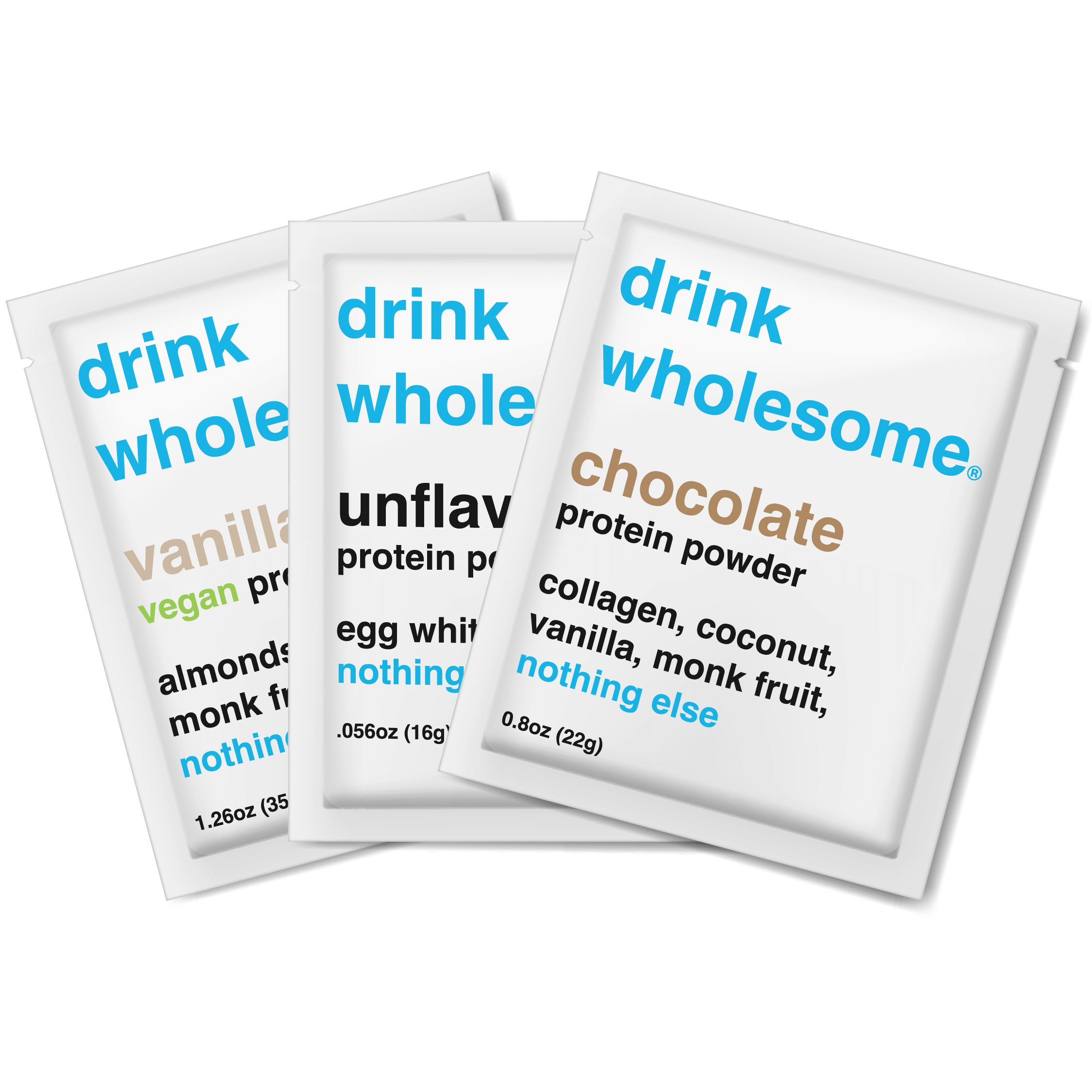
We make three types of stomach-friendly Protein Powder: Collagen Protein Powder, Egg White Protein Powder, and Vegan Almond Protein Powder. As long as you get protein from a variety of sources, any type of protein can help you meet your total daily protein needs. In other words, for someone with a balanced diet, there is no advantage to consuming one type of protein over another. Order Samples to see which type you like the most.

Ask Our Dietitian

If you’re wondering which Drink Wholesome product is best for you, ask our Registered Dietitian. For personalized medical advice, consult your healthcare provider.

Ask Nutrition Coach
Name
Name
First
Last