Orgain Protein Powder Review
📌 Overview and Key Takeaways
Is Orgain Protein Powder good for you?
This is a Certified Nutrition Coach’s in-depth Orgain Protein Powder review.

Orgain Protein Review
Orgain makes several different types and flavors of protein powder.
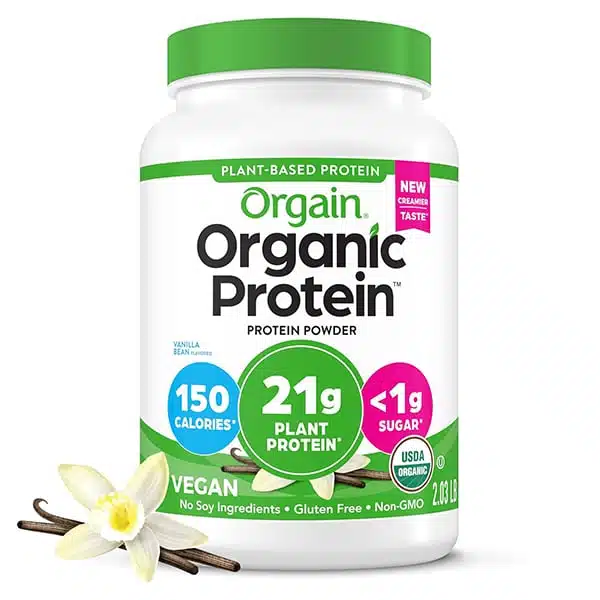
For the sake of simplicity, I am going to review their best-selling Organic Sweet Vanilla Bean Protein Powder.
Orgain Nutrition Facts
Because it is a protein supplement, I am going to start my Orgain review by talking about the Supplement Facts.
1 serving of Organic Sweet Vanilla Bean Protein Powder contains 150 calories, 4 grams of fat, 15 grams of carbohydrates, 0 grams of sugar, and 21 grams of protein.
At a first glance, Orgain protein powder appears to be a good source of plant-based protein.
It does contain more carbs than most protein sources, so it is not the most effective way to increase the percentage of your calories that come from protein, but that is only relevant if you are trying to restrict your calorie or carbohydrate intake.
If your goal is simply to eat more protein, Orgain is a good option.
It is worth noting that one serving contains 150 milligrams of sodium, which is relatively high, especially for a plant-based protein source.
Pea protein powder is often made by extracting protein from green or yellow split peas using a dilute salt solution.
Sodium from this solution stays with the extracted protein, so if you are on a low sodium diet, pea protein might not be the best choice.
Overall, Orgain’s Organic Sweet Vanilla Bean Protein Powder, despite containing more carbohydrates and sodium than other protein powders, is a good source of protein, especially for someone on a plant-based diet.
To really understand whether or not Orgain is a good for you, however, you have to take a close look at the ingredients.

Orgain Ingredients
The ingredients list is by far the most important indication of whether or not a protein powder is good for you.
And generally speaking, the fewer the ingredients, the better.
Unfortunately, there are over 15 ingredients in Organic Sweet Vanilla Bean Protein Powder.
15+ ingredients is usually not a good sign, so let us take a deep dive into what these ingredients are and how they are made.
Before doing so, I should note that Orgain is organic, meaning the ingredients were grown and processed without synthetic pesticides or genetically modified organisms GMOs.
Although this is a good thing, especially for the environment, just because something is organic does not mean that it is good for you.
Protein Concentrates and Isolates
Protein Blend
Orgain uses a blend of plant proteins in its vegan protein powders that includes pea protein, brown rice protein, and chia seed protein.
Ingredients are always listed in descending order by weight, so the primary source of protein is pea protein.
Pea protein, or pea protein concentrate/isolate, is made by extracting protein from green and yellow split peas.
Here is an overview of what that process looks like:
Step 1: Milling
- Whole peas are cleaned, dehulled, and ground into a fine flour.
- Note that this flour is not just protein; it is fats, carbs, and fiber all mixed together.
Step 2: Slurry & Solubilization
- The pea flour is dumped into giant vats of water to make a slurry.
- Chemicals are then added to force only the protein to dissolve.
- This is basically pea soup spiked with chemicals to tease apart its components.
Step 3: Isoelectric Precipitation
- The protein-rich liquid is shifted to the isoelectric point of pea protein (pH 4.5).
- At this pH, the proteins lose their charge, aggregate, and precipitate out of solution.
- In other words, they “curdle” into wet clumps, similar to how milk proteins form curds when making cheese.
Step 4: Neutralization & Washing
- The pea protein clumps are rinsed and neutralized (back toward pH 7) with more chemicals.
- This removes much of the natural color, flavor, and most of the non-protein nutrients.
Step 5: Separation & Refinement
- Industrial centrifuges and filtration systems further separate the protein.
Step 6: Drying
- The damp protein curds are fed into spray dryers.
- This turns them into a fine powder known as pea protein isolate.
In short, although it is made from a plant, pea protein is ultra-processed, which is not a good thing.
Ultra-processed protein sources have been mechanically and/or chemically stripped of enzymes, fiber, and other natural digestive aids that help you break them down.
You therefore might not digest them in the same way that you do whole foods, which could affect your gut health.
For example, one study shows that regularly consuming protein concentrates and isolates might disrupt your gut microbiome (Nutrients, 2018).
Another study shows that it could cause the formation of toxic byproducts in your gut (Mol Nutr Food Res, 2024).
If I were you, I would stick to minimally-processed protein sources like eggs or nuts.

Food Additives
Thickeners
Orgain contains four thickeners: acacia gum (which appears twice), guar gum, inulin, and xanthan gum.
Thickeners are notorious for causing digestive issues like bloating and diarrhea.
They are also associated with disruptions to the composition and function of the gut microbiome (Nat Microbiol, 2022).
These shifts, known as gut dysbiosis, might contribute to a range of chronic diseases, including obesity, diabetes, and certain cancers (J Exp Med, 2019).
Gut dysbiosis is so problematic because it can contribute to a cascade of issues, including intestinal permeability (a leaky gut lining), systemic inflammation, poor nutrient absorption (J Exp Med, 2019).
It is important to note that much of this research is still emerging, so more studies are needed to clarify these relationships.
That said, the preliminary findings suggest that because protein shakes and powders are something you consume regularly, if not every day, the cumulative effects of small amounts of potentially harmful ingredients is worth taking seriously.
Erythritol
Orgain sweetens its protein powders with erythritol, a controversial sugar alcohol.
Although the literature is genuinely mixed, some studies have found a link between elevated erythritol levels in the blood and cardiovascular events (Nat Med, 2023).
For this reason, many people choose to avoid erythritol out of an abundance of caution.
Natural Flavors
While food manufacturers are required to disclose their ingredients, natural flavor manufacturers are not (FDA regulations 21 CFR §101.22).
They can add solvents, preservatives, emulsifiers, carriers and other additives to a flavor that qualifies as “natural” under current regulations.
Stevia
Orgain also sweetens its protein powders with stevia, a sweetener derived from the stevia rebaudiana plant.
Although stevia is considered by many to be a natural alternative to artificial sweeteners like sucralose, it is not nearly as “natural” as many people make it out to be.
Stevia is often extracted using harsh chemicals like ethanol and methyl alcohol, which, some argue, makes it no more natural than the artificial sweeteners that it seeks to replace.
In fact, a recent class action lawsuit filed in California reached a $6.1 million settlement because it was ruled that a company falsely labeled and advertised its stevia sweeteners as natural.
Overall, the ingredients in Orgain protein powder leave a lot to be desired.
They are ultra-processed and half of them are food additives.
So if I were you, I would look for a healthier alternative.

Orgain Taste and Texture
Taste is so subjective that I hesitate to include it in this Orgain protein powder review.
A protein powder that one person loves might make another person gag, and if you read product reviews on Amazon, you will find both 5 star reviews and 1 star reviews evaluating the taste of the exact same recipe.
For the sake of this Orgain plant-based protein powder review, however, I will share my thoughts on how Orgain tastes and mixes.
Orgain mixes really well; I mixed it in a shaker bottle, and did not notice any clumps or grit.
It also has a nice creamy texture, and if you follow the serving suggestion, makes a thick shake.
The flavor, on the other hand, is not my favorite.
It is way too sweet, and has the chalky aftertaste characteristic of most protein powders.
In order to stomach a full serving, I had to blend it with other ingredients.
That said, plenty of people seem to like Orgain, so take my opinion with a grain of salt.
Sources
- Nutrients (Nutrients). Effect of a Protein Supplement on the Gut Microbiota of Endurance Athletes: A Randomized, Controlled, Double-Blind Pilot Study. 2018.
- Molecular Nutrition & Food Research (Mol Nutr Food Res). In Vitro Fermentation of Animal and Plant Protein Isolates by the Human Gut Microbiota Under High and Low Carbohydrate Conditions.. 2024.
- Nature Microbiology (Nat Microbiol). Mechanistic insights into consumption of the food additive xanthan gum by the human gut microbiota.. 2022.
- The Journal of Experimental Medicine (J Exp Med). The gut microbiome: Relationships with disease and opportunities for therapy. 2019.
- Nature Medicine (Nat Med). The artificial sweetener erythritol and cardiovascular event risk.. 2023.
- Cornell Law School. 21 CFR § 101.22 – Foods; labeling of spices, flavorings, colorings and chemical preservatives.
Editorial Guidelines
This article was written by a Certified Nutrition Coach and reviewed by a Registered Dietitian. We rely on peer-reviewed research and trusted medical sources, and regularly update our content to ensure accuracy and clarity.
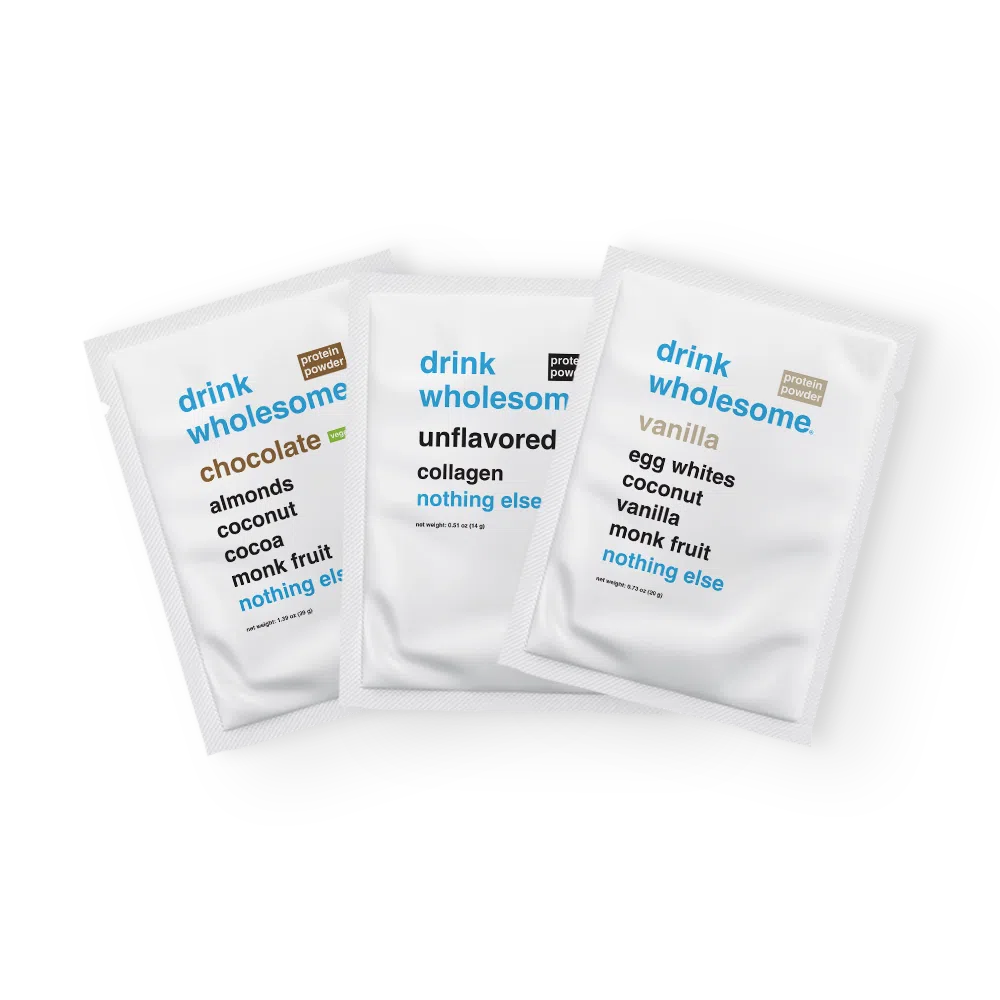
Drink Wholesome makes protein powder for sensitive stomachs, GERD, IBS, and other gut issues. It’s suitable for most food sensitivities, including lactose intolerance, and won’t cause side effects like bloating, constipation, and reflux. Drink Wholesome is the best protein powder for sensitive stomachs because it’s additive, dairy, and gluten-free. It’s also made from minimally-processed protein sources like egg whites and almonds. Other protein powders are made from ultra-processed protein concentrates and isolates, which look nothing like real food. Drink Wholesome makes gut-friendly Protein Powders and Meal Replacement Powders. Protein powder is high in protein and low in everything else, whereas meal replacement powder contains fats, carbs, fiber, and protein because it’s intended to replace the nutritional value of a balanced meal. We make three types of stomach-friendly Protein Powder: Collagen Protein Powder, Egg White Protein Powder, and Vegan Almond Protein Powder. As long as you get protein from a variety of sources, any type of protein can help you meet your total daily protein needs. In other words, for someone with a balanced diet, there is no advantage to consuming one type of protein over another. Order Samples to see which type you like the most. If you’re wondering which Drink Wholesome product is best for you, ask our Certified Nutrition Coach. For personalized medical advice, consult your healthcare provider.
Frequently asked questions
Who Is Drink Wholesome for?
Why Is Drink Wholesome Good for Sensitive Stomachs?
What’s the Difference Between Protein Powder and Meal Replacement Powder?
What’s the Difference Between Almond, Collagen, and Egg White Protein?
Ask Nutrition Coach
PREP TIME 5 min COOK TIME 5 min SERVES 2 Combine the Protein Powder, nut butter, syrup, extract, and oats in a food processor or blender. Pulse until well combined. Add the chocolate and coconut, and pulse a few more times. Roll the dough into 10 balls. Enjoy!High Protein Balls
Ingredients
Instructions
Author(s)
Protein Powder Samples
Starting at $9.99
BUY NOW